RS Logo

Market Note: Judgment Day for Software?

February 20, 2026 – After almost a year of AI euphoria, the stock market recently plunged into AI blues. Once seen as a great boost to all things technology, overnight AI turned into an imminent threat to software companies whose products are now seen as ripe for disruption.

While fears around the fate of software companies are probably overblown—these companies do more than just write code, and their mission critical functions, complex integrations, ongoing maintenance, and security features won’t be easily replaced by vibe coding—the fear itself signals the extent to which we are all struggling to imagine how AI is going to change our economy. These fears are everywhere, casting a long shadow that reinforces a broader sense of an unsettled society.  

In this period of great technological innovation, history provides a useful guide for how the story could unfold. Sure, AI is a different, more powerful, and possibly faster evolving technological change than we’ve seen before, but it is still wielded by humans (for now?) who will seek to benefit from it. This will drive familiar behaviors of greed, fear, loss aversion, and adaptation, and ultimately will settle into a new normal with new winners and losers. Just like sewing machines, steam engines, the internet, or smartphones.

One possible outcome of the emergence of AI is a shift of financial and human capital, effort, and energy away from software and back into the world of hardware and industry. For decades, investment in software has soaked up our money, time, and the best minds of our generation. If AI reduces the marginal cost of software creation, capital and talent may increasingly flow toward physical industries, infrastructure, and applied science.

Only time will tell what opportunities AI will open to us, and how the victims of this change—those trained for jobs that may disappear—will fare. In the meantime, don’t expect software companies to be the last “victim” of AI cyclicality. Hardly. The speed of the turn against them is a testament to the herd mentality—the animal spirits—that govern the stock market. These are the same investors who pushed these stocks to new heights, supported by expectations of AI-driven productivity gains. That narrative is as true today as it was in December, perhaps even more so. What’s changed is how investors are choosing to interpret the story-driven productivity gains. That narrative is as true today as it was in December, perhaps even more so. What’s changed is how investors are choosing to interpret the story.‑driven productivity gains. That narrative is as true today as it was in December, perhaps even more so. What’s changed is how investors are choosing to interpret the story.
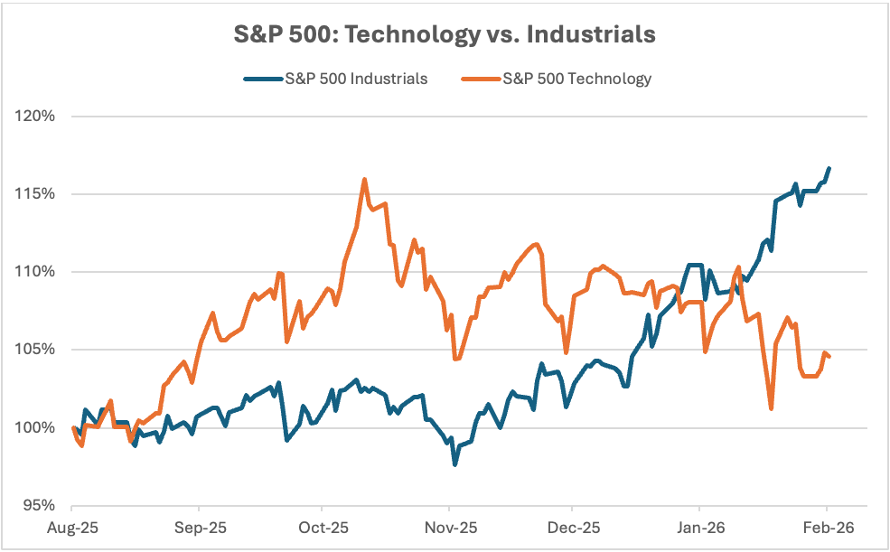
Chart 1: S&P 500: Technology vs. Industrials, 8/19/25-2/19/25.  Performance of the tech industry has been volatile as investors fret over the impact of AI on the sector. Source: Bloomberg, 2/19/26

Please don’t hesitate to reach out with any questions or concerns.
Schedule a time to speak with me.

— AMD

Disclosure and Source

Investment advisory services offered through Robertson Stephens Wealth Management, LLC (“Robertson Stephens”), an SEC-registered investment advisor. Registration does not imply any specific level of skill or training and does not constitute an endorsement of the firm by the Commission. This material is for general informational purposes only and should not be construed as investment, tax or legal advice. It does not constitute a recommendation or offer to buy or sell any security, has not been tailored to the needs of any specific investor, and should not provide the basis for any investment decision. Please consult with your Advisor prior to making any investment decisions. The information contained herein was compiled from sources believed to be reliable, but Robertson Stephens does not guarantee its accuracy or completeness. Information, views and opinions are current as of the date of this presentation, are based on the information available at the time, and are subject to change based on market and other conditions. Robertson Stephens assumes no duty to update this information. Unless otherwise noted, any individual opinions presented are those of the author and not necessarily those of Robertson Stephens. Performance may be compared to several indices. Indices are unmanaged and reflect the reinvestment of all income or dividends but do not reflect the deduction of any fees or expenses which would reduce returns. A complete list of Robertson Stephens Investment Office recommendations over the previous 12 months is available upon request. Past performance does not guarantee future results. Forward-looking performance objectives, targets or estimates are not guaranteed and may not be achieved. Investing entails risks, including possible loss of principal. Alternative investments are speculative and involve substantial risks including significant loss of principal, high illiquidity, long time horizons, uneven growth rates, high fees, onerous tax consequences, limited transparency and limited regulation. Alternative investments are not suitable for all investors and are only available to qualified investors. Please refer to the private placement memorandum for a complete listing and description of terms and risks. This material is an investment advisory publication intended for investment advisory clients and prospective clients only. Robertson Stephens only transacts business in states in which it is properly registered or is excluded or exempted from registration. A copy of Robertson Stephens’ current written disclosure brochure filed with the SEC which discusses, among other things, Robertson Stephens’ business practices, services and fees, is available through the SEC’s website at: www.adviserinfo.sec.gov. © 2026 Robertson Stephens Wealth Management, LLC. All rights reserved. Robertson Stephens is a registered trademark of Robertson Stephens Wealth Management, LLC in the United States and elsewhere. A3061

Talk To Us