Anyone who has spent time recently with their favorite AI tool can’t help but notice that we are on the precipice of a dramatic technological leap. AI has moved past the realm of promise and into a stage of maturity where it is improving the lives of those who use it. It’s both an exhilarating and a terrifying moment. Change is scary, even for those who benefit from it, and inevitably some people and organizations will be left behind.
As investors process this mix of optimism and fear, they are highly attuned (one might say overreactive) to any clue about what the future holds. Take the midterms. Markets initially cheered the Democratic wins, with the S&P 500 rising 1.6% and the Dow jumping more than 1,500 points on November 4. That optimism lasted exactly one day. On November 5, fears that a new Congress, along with local ballot measures restricting new data centers, could slow the buildout of data centers, on top of worries about the rising cost of financing them, sent the S&P 500 down 4.4% and the Nasdaq down 5.5% in the market’s worst day since Liberation Day in April 2025.[1]
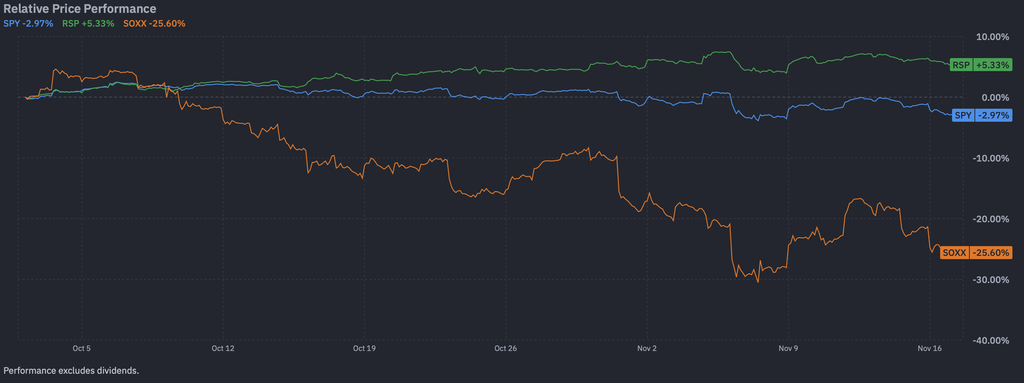
The chipmakers, once the poster children of AI optimism, have had an especially rough ride. It began in October, when Intel fell nearly 29% in a single day after a weak forecast, its worst day since 1974. The rout spread across semiconductor stocks despite strong third-quarter results, including a near doubling of AMD’s data-center revenue.[1] It culminated in Nvidia’s slide after CEO Jensen Huang’s abrupt resignation and amid reports of growing congressional scrutiny of the company’s chip sales into China. The iShares Semiconductor ETF is now down about 26% since the start of October. Other leaders of the AI race have stumbled too. Alphabet fell more than 10% in a single day after reporting a second straight quarter in which its capital spending outran the cash its business generated, and both Alphabet and Meta fell double digits in October alone.[2]
But in their fervor to abandon these tarnished darlings, investors aren’t leaving the stock market. They are moving around inside it, which suggests a rotation rather than an exit. Since the beginning of October, the S&P 500, which weights companies by size, is down about 3%. By contrast, the equal-weight S&P 500, which gives every company the same weight regardless of size, is up 5.3% (Chart 1). In other words, the typical stock is beating the giants by a wide margin. That’s a meaningful shift for a market dominated for much of the past few years by the Magnificent 7 and their mega-cap descendants. Leadership came from unglamorous corners. In October, energy led all sectors with a 14% gain, followed by defensive sectors, with consumer staples, utilities and health care each rising about 10% or more. For the month, the equal-weight index beat the S&P 500 by about 6%, the widest margin since April 2009.[3]
The bond market, meanwhile, went through its own contortions. Yields fell after the midterms as oil dropped sharply on hopes that a deal with Iran could reopen the Strait of Hormuz. Then the data turned. A strong October jobs report, with 165,000 jobs added, was followed by an October Consumer Price Index showing inflation still running above the Fed’s target. At its October meeting, the Fed held rates steady, but two policymakers voted for a hike.[4] Fed officials have since grown even more hawkish, with Governor Christopher Waller even floating a half-point hike in December. The 10-year Treasury yield rose every day last week, from about 4.86% to 5.15%. These higher rates matter for the AI story because they raise the cost of the borrowing that is funding the enormous buildout.
Despite these roadblocks to the AI giants, the market isn’t giving up on AI. Rather, investors are questioning whether the companies building the infrastructure can keep spending at this pace, while rewarding the much wider set of businesses that stand to benefit from using the technology. For long-term investors, it’s a reminder of why diversification matters. Over time, market leadership tends to rotate, and today’s winners mean-revert, just like the losers.
In all, we enter this holiday season with both promise and fear. The promise of great technological advance: a world with less busywork, where (even more of) our daily hassles are handled on our behalf. And the fear of not knowing who, individuals and companies alike, will be the winners and losers of this great change. As investors, let us strive to be driven by neither greed nor fear. We are living through an incredible period of technological change, and this Thanksgiving, I hope to welcome it with gratitude.
Please reach out if you would like to discuss how these shifts may affect your portfolio. Wishing you and your loved ones a happy Thanksgiving.
— AMD





Robertson Stephens paid no fee to obtain recognition but has paid licensing fees to reference its appearances on the Newsweek, USA Today, and FA Magazine rankings lists. See Awards Disclosures